
I was 35 pounds heavier than I am now. My cholesterol was through the roof. I had a heart condition. And I was still checking my emails.
I want to start there because this is the part of my own story I almost never tell. By that point, my body had been screaming at me for years. I just could not hear it over how good I was at my job. Promotions. Bonuses. A title with weight to it. I was the person other people relied on, and I was very good at being relied on.
Then I sat in a cardiologist’s office and watched a man I had just met essentially ask me to choose between my career and my heart. I quit a few days later. Thirty years in corporate, gone. No plan. No savings buffer. Total identity crisis.
That moment is where this week’s episode of The Comeback Show lives. And the conversation I had with my guest, Miriam Brait, is the one I needed someone to put in front of me a decade earlier.
Miriam is a 31-year-old licensed psychologist in Romania and an attachment-focused, trauma-informed coach who works with high-functioning women all over the world. I am 52. She lives in Bucharest. I live in Seattle. And what we found, in the most surprising way, is that the gap between us was not a gap at all. It was the point.
Because the patterns we kept circling — the high-functioning trap, the way attachment quietly wires who we end up attracted to, the slow erosion of self-trust we mistake for destiny — they do not care about generation. They show up in a young psychologist in Eastern Europe and they show up in a midlife reinvention coach who walked away from corporate nine months ago. And the work to get free of them looks remarkably similar, no matter where you are in the timeline.
Miriam writes the Substack Past the Past, which I have been quietly loving for months. Her writing sits at the intersection of psychology, neuroscience, and lived experience, and she does not write at clinical distance. She writes like someone who has been through it. Which she has.
Three things from our conversation I want you to leave with
One: We have turned ourselves into “human doings” instead of human beings.
Here is the line from Miriam that I cannot stop thinking about:
“Even our free time gets weaponized. We don’t actually rest. We schedule a hobby. We go to the book club. The free time becomes another performance.”
She traced the trap back to its source. Conditional self-worth. The version of self-esteem that has to be re-earned every day through achievement, output, productivity, looking good in the meeting, the right answer at the family dinner. Underneath that is the part that has gone missing in so many of us. Unconditional self-worth. The quiet knowledge that you are a human being, and your rest does not have to be earned, and work is a tool, not your identity. As Miriam put it:
“I don’t serve work. Work serves me.”
If you have caught yourself this week scheduling your downtime, optimizing your hobby, or feeling guilty for a Saturday afternoon nap, you are living inside the trap. The trap is not a personal failure. It is a learned strategy that worked once. And it has a cost.
Two: Attachment doesn’t just shape how you behave in a relationship. It wires who you’re attracted to in the first place.
This was the insight that broke me open in the episode. I had always understood attachment as the way someone behaves inside a relationship. How anxious they get. How avoidant they get. Whether they pull away or chase.
Miriam said something different. She said attachment also shapes who you choose before the relationship has even started. The anxiously attached woman gravitates toward people who are unavailable, because their unavailability matches the early caregiver pattern her nervous system learned to read as love. The avoidantly attached person picks people they can find flaws in, then leaves the moment closeness becomes real. The disorganized attachment lives in the on-again-off-again loop. None of this is bad luck. None of it is destiny. It is a learned pattern doing exactly what it learned to do.
And the painful part: without this framework, women keep calling the pattern destiny. “This is just who I end up with.” “This is just my luck.” For most of us, the first step out is realizing the pattern is not a fact about us. It is a piece of programming that can be updated.
Three: True power is letting go of the fantasy of perfect.
I asked Miriam at the end of the conversation what she most wanted listeners to take away. I expected something tactical. What she gave me was bigger.
I think true power is leaving the fantasy that we can be perfect. We’re always going to have people who see us and really appreciate us, and we’re going to have people who don’t like us. I think it’s far more powerful to allow people to love you as you are instead of fighting for the love of people who don’t love you as you are.
Read that twice. The version of us we have been performing for is the one that pays for the love of the people who do not actually love us. The work is putting down the performance. Letting the people who already love us actually love us. Letting the rest go without making them wrong.
This week’s invitation
If you have been in the version of midlife where pushing harder has quietly stopped working, this episode is for you. If you have a shelf full of attachment books and you are still in the same painful relational loop, this episode is for you. If you are in a job you are very good at that is also costing you your health, please listen.
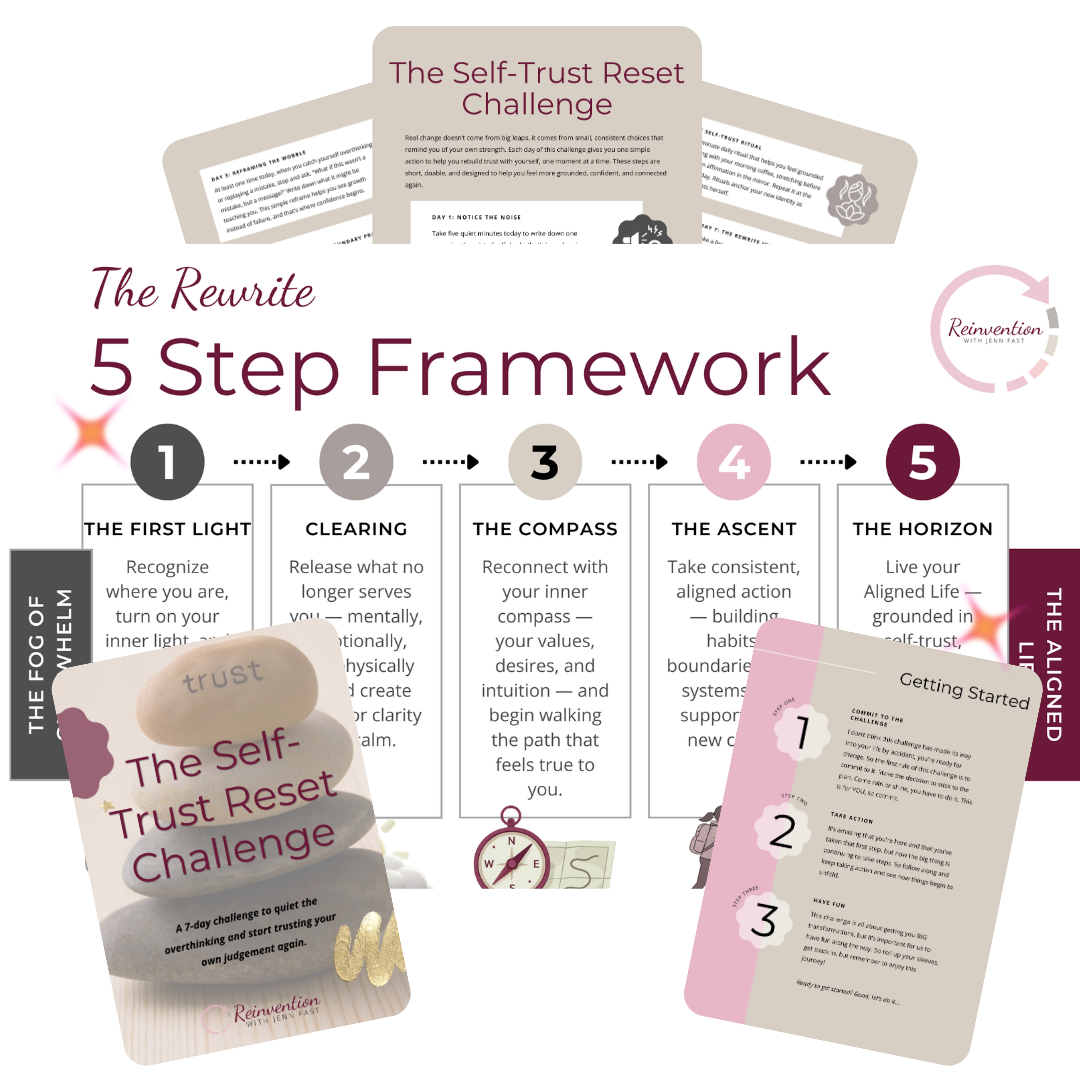
And here is the thing I want to leave you with personally. The through line in everything I do at Reinvention with Jenn Fast is moving women from survival mode into self-trust. Not as a slogan. As a practice. As something you build day by small day. That is exactly what this episode is about. And it is exactly what my free five-day Self-Trust Reset Challenge is built to help you start.
If today’s conversation lit something up in you, that is where I would point you. Five short days. One small daily practice. A starting place for the woman who knows performing harder isn’t the answer but isn’t sure what is.
What to do next
Listen to the full episode: Why Knowing Your Attachment Style Isn’t Enough on Substack
Follow Miriam: pasthepast.com — her Substack is one of the most thoughtful psychology newsletters I read. Subscribing is the easiest yes here.
Book Miriam’s free 15-minute call:

— if relationships, attachment, or family-of-origin patterns are the work in front of you, she is who I would refer you to.
Join my free Self-Trust Reset Challenge: https://reinventionwithjennfast.com/self-trust-reset-optin-858120 — a free five-day reset for the woman who knows performing harder isn’t the answer.
Jenn
P.S. I record and edit every Comeback Show episode on Descript. If you’ve been quietly mapping your own podcast, save money as you build it, my affiliate link is here: https://descript.cello.so/g2QH5pFVYG6